Vegemite (Australian Yeast Spread)
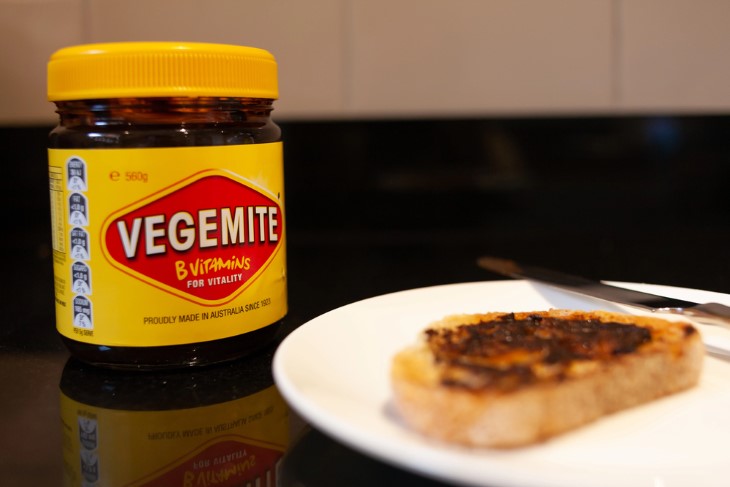
Nutritional Profile: Vegemite is a thick, dark, savory spread made from
yeast extract and fortified with B-vitamins. It’s very different from
nut butters or cream cheese—it’s extremely low in calories and
macronutrients but very high in certain vitamins. A typical serving is
only 1 teaspoon (5 g), since the flavor is strong. Per teaspoon,
Vegemite has about 9–11 calories, 1.3 g protein, 0 g fat, less than 1 g
carbs (with less than 0.5 g sugar and ~0.3 g fiber). Where Vegemite
really stands out is its micronutrient content: that tiny 5 g serving
provides roughly 50% of the RDI for vitamin B1 (thiamine), 50% for
vitamin B9 (folate), 25% for vitamin B2 (riboflavin), and 25% for
vitamin B3 (niacin). Some varieties of Vegemite (like the Reduced Salt
version) are also fortified with vitamins B6 and B12, but the standard
Vegemite does not contain B12. It’s essentially a B-vitamin powerhouse.
Vegemite also contains a notable amount of sodium: one teaspoon has
about 173 mg of sodium (roughly 7–8% of the recommended daily limit). It
has negligible potassium, no vitamin C, etc., but it does have small
amounts of iron due to the yeast extract. Vegemite is often considered
more of a condiment than a source of calories or protein—people spread a
very thin layer on bread or crackers, usually with butter or margarine.
Ingredients and Allergens: Vegemite’s main
ingredient is brewer’s yeast extract, a byproduct of beer brewing. This
yeast extract inherently contains gluten because it’s derived from yeast
grown on malted barley and wheat. Thus, Vegemite is not
gluten-free—those with celiac disease or gluten sensitivity should avoid
standard Vegemite (there are some newer gluten-free yeast spreads in
the market, but the classic Vegemite contains barley). Aside from yeast,
Vegemite includes salt, vegetable extract (for flavor), and added B
vitamins (thiamine, riboflavin, niacin, folate). It does not contain any
fat, sugar, or animal products, meaning Vegemite is naturally vegan and
vegetarian (it’s basically fermented yeast and additives). It also
contains no dairy, egg, or soy. The primary allergen of concern is the
gluten from barley/wheat. Marmite, a similar British spread, is likewise
not gluten-free unless specified. Vegemite is fine for those with nut
allergies, lactose intolerance, etc. It is extremely salty, so people on
sodium-restricted diets need to consider that. Diet-wise: Vegemite is
suitable for vegan diets (in fact, it’s a beloved source of B12 for some
vegans if they get the version with B12 or its UK cousin Marmite, which
has B12). It’s also keto-friendly and low-carb—the carb content in a
teaspoon is under 1 gram, which is trivial. The only diet it squarely
conflicts with is gluten-free (unless a special gluten-free formulation
is used). Also, some ultra-specific diets like low-sodium diets or
low-purine diets (for gout) might limit Vegemite because yeast extract
is high in purines and obviously salt.
Health Benefits: Vegemite is often touted for its rich B-vitamin
content, which have numerous benefits. Thiamine (B1) is essential for
converting carbohydrates into energy and proper nerve function—adequate
B1 prevents beriberi and supports appetite and growth, and Vegemite
providing 50% of B1 RDI in a tiny serve is significant for people who
might be deficient. Folate (B9) is important for DNA synthesis and
especially crucial during pregnancy for preventing neural tube
defects—Vegemite’s high folate can help boost intake (in fact, during
World War II, Vegemite was promoted to children and pregnant women for
its folate and other B vitamins). Niacin (B3) and Riboflavin (B2)
support metabolism, skin health, and the nervous system—Vegemite
delivering ~1/4 of these vitamins’ daily needs can contribute to
preventing deficiencies like pellagra (niacin deficiency). Vegemite’s
vitamins are in a readily bioavailable form, and some doctors and
dietitians in Australia recommend Vegemite as a simple way to increase
B-vitamin intake, especially for those on vegetarian diets. Vegemite is
extremely low in calories, sugar-free, and fat-free, so it can add
flavor without adding much energy—useful for people trying to reduce
calorie intake or limit sugar (it’s a savory alternative to sweet
spreads). It contains natural glutamates (from the yeast extract), which
give an umami flavor that can enhance the palatability of foods and
might help reduce the need for excess salt if used as a seasoning
(though Vegemite itself is salty). Some research on B-vitamin
supplementation indicates benefits like improved energy levels, better
mood, and cognitive function in individuals who are deficient—Vegemite
has been humorously credited with Australians’ general vitality, but
there’s some truth that having these vitamins covered can make a
difference if one’s diet was lacking. For mental health and brain
benefits, there’s preliminary evidence that B-vitamin-rich spreads like
Vegemite might be linked to lower stress and anxiety levels, possibly
due to the role of B vitamins in the nervous system—one study found
people who regularly consumed yeast-based spreads had lower stress and
anxiety scores than those who didn’t, hypothesizing the B vitamins as a
cause. Vegemite has no preservatives or artificial colors/flavors; it’s a
simple product, which is a “clean label” advantage for those concerned
about food additives.
Health Deficits & Risks: The main health concern with Vegemite is
its high sodium content. Salt is the second major ingredient after
yeast—a small 5 g scrape gives ~7% of a day’s sodium limit. Many people
use even more than a teaspoon if they really love the taste (though
Australians typically caution newcomers to use it sparingly!). Diets
high in sodium are associated with elevated blood pressure and an
increased risk of hypertension and stroke. If Vegemite is used
generously every day on top of an already salty diet, it could
contribute to excessive sodium intake. However, for most, the serving is
so small that it remains a minor part of total salt intake. Another
issue is that Vegemite’s strong taste often means it’s eaten with butter
or margarine on bread—so indirectly, one might consume extra butter
(saturated fat) along with Vegemite, but that’s not Vegemite’s fault per
se; it’s just a common combination. Vegemite itself has virtually no
fats or sugars, so from a macronutrient standpoint, it’s not harmful.
There are no significant long-term toxicities associated with
Vegemite—the B vitamins are water-soluble, so it’s hard to overdose via
Vegemite (you’d get full from the saltiness long before reaching toxic
vitamin levels). One could theoretically get too much folate or niacin
if eating massive amounts daily, but that scenario is unlikely. A minor
point: Vegemite is rich in purines (from yeast extract), which can be
metabolized into uric acid—individuals with gout or high uric acid
levels might need to moderate purine-rich foods, and eating a lot of
Vegemite could potentially trigger gout in sensitive persons, similar to
how yeast and meat extracts do.
Also, some people have reported headaches or MSG-like sensitivity to
glutamate-rich foods—Vegemite’s natural glutamates might in rare cases
cause a reaction like a headache in MSG-sensitive individuals, though
this is anecdotal. Allergen-wise, the presence of gluten is a risk for
celiac patients—even a small amount of Vegemite could cause an
autoimmune reaction in them, so that’s a strict no for that group.
Additionally, Vegemite has no B12 (unless fortified in special
versions), so vegans should note it’s not a source of B12 (Marmite in
the UK is fortified with B12; Vegemite’s new versions may be, but
classic isn’t)—relying on Vegemite for all B vitamins except B12 is
fine, but you’d still need B12 from elsewhere. Finally, taste-wise, one
could joke that an American slathering Vegemite thickly like peanut
butter might face a “health risk” of gagging—it’s meant to be eaten
sparingly!
Daily Use and Long-Term: For someone who enjoys the taste, using a small
amount of Vegemite daily (for example, on a slice of toast) can
actually be beneficial, as it virtually acts like a daily B-vitamin
supplement. Australia’s history of Vegemite shows it was used in WWII to
prevent vitamin deficiencies among troops and civilians. If you eat
Vegemite daily, you’re very unlikely to ever develop deficiencies in
thiamine, niacin, or folate. Long-term, this could support brain health
(some B vitamins like folate and B12—if present—are linked to cognitive
health and preventing neural tube defects in pregnancy, etc.). The added
salt intake from a daily Vegemite habit is something to watch,
especially if you have or are at risk for high blood pressure. However,
an average person using a tiny amount shouldn’t worry too much—the
analysis of Vegemite concludes that its high sodium shouldn’t be a
concern since people generally use tiny amounts; if you’re worried,
choose the reduced-salt version. There is a reduced-sodium Vegemite
available that cuts salt by 25% and even adds B6 and B12, making it
arguably even healthier. Long-term, Vegemite doesn’t have the caloric
impact of other spreads (so it won’t contribute to obesity—it’s
practically calorie-free in the amounts used). It might, in theory, help
maintain B-vitamin levels, which could keep homocysteine levels in
check (folate, B6, B12 reduce homocysteine, a cardiovascular risk
factor—but Vegemite standard lacks B12).
If someone with alcoholism (a risk for thiamine deficiency) uses
Vegemite, it could help stave off Wernicke’s encephalopathy, etc.—these
are very specific cases but illustrate how nutrient-dense it is in terms
of vitamins. In Australian culture, many people do eat Vegemite on
toast regularly, and there’s no evidence of harm; in fact, you’ll find
centenarians who swear by their daily Vegemite. The only caution would
be if one has to be on a low-salt diet—they might have to give up
Vegemite or strictly limit it (since even a little can be a significant
portion of a very restricted sodium allowance). In conclusion, Vegemite
is a uniquely healthy spread in terms of micronutrients, provided it’s
used as intended—sparingly. It’s a great choice for those who need to
avoid sugar and fat or who want a vegan savory spread. Just mind the
salt and remember it contains gluten, so it’s not for everyone.

No comments:
Post a Comment