Showing posts with label boiled water. Show all posts

Sunday, November 23, 2025

Carrot- Betroot Kanji- Healthy Probiotic drink

What is Kanji

Kanji is a probiotic drink made in the Northern Indian states. You can compare it with Kombucha, but the process of making kanji is entirely different than Kombucha.

Being a probiotic drink it is extremely good for the gut and improves digestion. Traditionally Kanji recipe is made with black carrots and this drink has a dark purple color. I do not get black carrots and I make this healthy drink with red carrots.
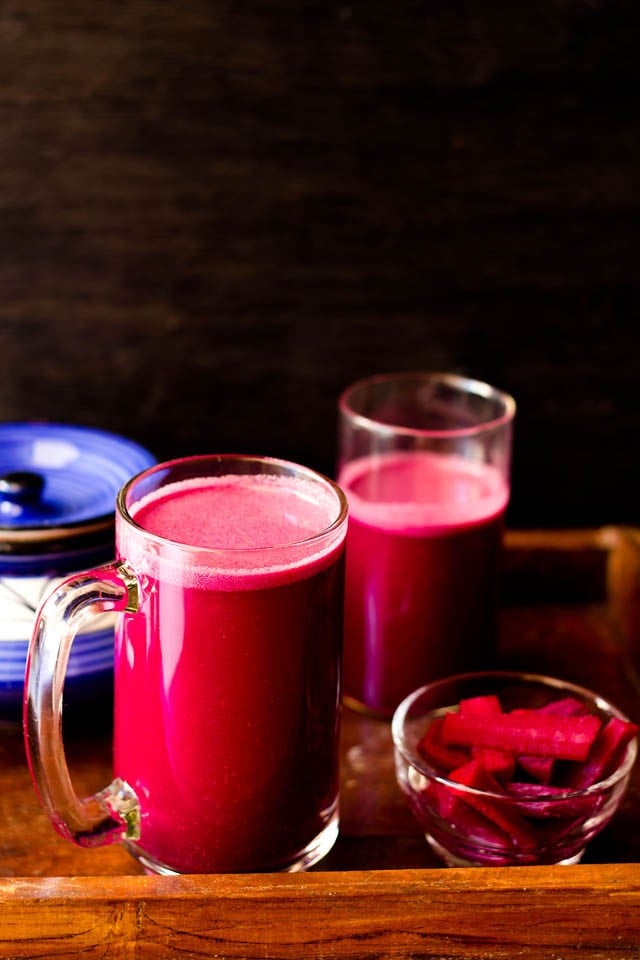
 purple reddish colored kanji drink in a glass jar with pickled carrots, beets in a small bowl with ceramic jar and a glass jar with kanji in the background. 

Kanji is spiced with ground mustard seeds, red chilli powder and black salt or salt. The carrots, spices, seasonings are mixed with some boiled cooled water and kept to ferment for a few days.

The entire drink with its ingredients is filled in a glass or ceramic jar. These jars are kept in the sunlight and the drink is allowed to ferment for 2 to 3 to 4 days.

It depends on how the sun is behaving in your region. So the drink can be kept for 4 to 5 days if the sunlight is not enough. If it is hot or very hot, then 1 to 2 to 3 days are enough for the drink to get naturally fermented.

The mustard in the kanji drink keeps the body warm during the cold winters of North India. The fermentation process changes the flavors of the drink and makes it probiotic. The taste is mild sweet and sour with that unique aroma of a fermented drink.

Kanji is served as an appetizer drink. It has a sour, spicy and pungent taste. This taste is an acquired one – either you will like or won’t like it, just like Kombucha.

  • First boil water and let it cool at room temperature. Cover the pan when the water cools.
  •  In a clean ceramic or glass jars with a wide mouth, add the carrots, beets, ground yellow mustard powder, black salt, pink salt or regular salt and red chili powder or cayenne.
  •  Mix all the ingredients with a clean dry spoon.
  •  Cover with loosely with a lid or secure and tie a muslin cloth/cheese cloth on the top of the jar or bottle.  Keep the jars in the sun for 2 to 3 days or up-to 4 to 5 days depending on the sunlight in your area.
  •  For an intense and strong sunlight, about 1 to 2 days is good enough for fermentation. When there are cloudy days and less sunlight, 4 to 5 days will work. But do ensure that your kanji drink is fermented well.  Do not keep so long that will make your drink over fermented.
  •  Stir with a wooden spoon or shake the jar everyday.
  •  
    When the kanji tastes sour, it means the drink is fermented.
  •  Serve carrot kanji straightway or refrigerate. It stays good in the fridge for about 4 to 5 days.
  •  You could add a few ice cubes while serving or refrigerate to make it cold before serving.
  •  Drink the kanji before meals or anytime during the day. Serve the fermented carrot and beets sticks as a pickle condiment with any Indian main course.
  •  The sour-tangy carrots and beets can be included in a salad or add as toppings to your wraps, burgers or sandwiches.

  • The sour-tangy carrots and beets can be included in salads or as toppings to your wraps, burgers or sandwiches.


    Expert Tips

    • Cleanliness: Any fermented drink need care so that you do not end up with bad microbes in it. Ensure that your jars, spoons, chopping boards, knives are all clean and dry. If you see any layer of fungus, then throw away the drink. If the drink has an awful smell, that means it has gotten bad, so discard it.
    • Mustard: You can choose to use both black or yellow mustard. However keep in mind that black mustard has a more pungent flavor, so add lesser amount of it – about 1 to 1.5 tablespoons. I have used yellow mustard which is milder.
    • Boiling water: I highly recommend to boil water and cool it at room temperature. This way you rule out your kanji going bad. Tap water or even machine filtered water can spoil the drink.
    • Variations: Together with carrots and beets, you can include turnips and peeled watermelon rinds in the drink. You do not need to add any sugar or sweetener in this drink as the natural sugar, starches in the carrots and beets help the friendly bacteria to feed on and ferment the drink naturally.


    Can you reuse the veggies left after making kaanji?
     

    YES — and you absolutely should!

    They’re full of lacto-fermented good bacteria, which means:


    They’re great for the gut and digestion

    They act like a natural pre-probiotic feeding and supporting healthy 

    gut flora

    And the best part?
     

    They taste amazing and are so versatile.

    Kanji vada  and instant kanji aachar see my next posts.


    https://gscrochetdesigns.blogspot.com. one can see my crochet creations  

    https://kneereplacement-stickclub.blogspot.com. for info on knee replacement

    https://cancersupportindia.blogspot.com  for info on cancer and health related topics

    https://GSiyers home remedies.blogspot.com   is the latest addition to my blogs


    Monday, September 29, 2025

    Yes, There’s a Right Way to Boil Pasta Water—Here’s Why It Matters

    “The easiest way to get a transcendent bowl of pasta is to control as many variables as you can,” says McFadden. And when it comes to cooking the noodles, the ratio of salt to water is clutch, for a couple of reasons. First, the noodles are seasoned by the cooking liquid. They absorb a small amount of the salt as they cook, making for a much tastier noodle. 

    Second, for many pasta recipes, especially those in Six Seasons of Pasta, the cooking water becomes an important ingredient in the sauce. You reserve a cup or so of water before draining the pasta, combine the pasta and the sauce (which has probably been bubbling away on a nearby burner), and add some pasta water to the mixture. The liquid loosens up the sauce and adds starch (that the pasta sheds as it cooks), which helps the sauce cling to the noodles. Thanks to that salt, the cooking water also adds flavor. Too much or too little salt makes for a less-than-sublime finished dish.

    TIP -Reserve and save pasta water to add flavor and body to soups. Use it instead of a portion of the broth, or follow a recipe like this one.

    Be Specific With the Salt

    Many pasta recipes direct cooks to salt the cooking water “generously,” but McFadden calls for a particular amount for a reason. “The word ‘generously’ means something different to everyone,” he says. “The specificity ensures that salting becomes second nature. This is particularly important when the starchy, salty liquid becomes a component of your sauce. If you have it correct from the beginning, you won’t have to mess around to find a way to fix it later.”

    As for what type of salt to use, like many chefs and other culinary pros, McFadden prefers kosher salt, and Diamond Crystal in particular. Because the flakes are lighter and airier, it’s actually less salty by volume than Morton’s kosher salt. If all you can find is Morton’s, use about half as much as McFadden's technique calls for. 

    How to Boil Water

    Without further ado, here's the method: Start by filling a six-quart or larger pot with a gallon of water (that's 4 quarts or 16 cups). Add a quarter cup of Diamond Crystal kosher salt (or 2 1/2 tablespoons of Morton's), and bring the water to a boil. Truthfully, it doesn’t matter if you salt the water at the beginning or right before adding the pasta, McFadden explains. Just be consistent, so you don’t forget entirely or accidentally salt twice. “Add the noodles, slap on the lid, and then, once the rolling boil resumes, remove the lid so you can monitor the progress of your pasta more easily,” he says.

    Finally, if you’re tempted to add olive oil to the water, resist the urge. As McFadden says in Six Seasons of Pasta, "A coating of oil on the pasta will make it difficult for the sauce to cling to the noodle." All you need in that pasta water is salt, and preferably just the right amount.


    https://gscrochetdesigns.blogspot.com. one can see my crochet creations  

    https://kneereplacement-stickclub.blogspot.com. for info on knee replacement

    https://cancersupportindia.blogspot.com  for info on cancer and health related topics

    https://GSiyers home remedies.blogspot.com   is the latest addition to my blogs


    Thursday, September 26, 2024

    Figs and Oatmeal Muffins

     Ingredients:

    • Instant oats – 1/2 cup
    • Boiled water – 1/2 cup
    • Maida/ all purpose flour – 1 1/4 cup
    • Baking powder – 1 tsp
    • Caster sugar – 3/4 cup
    • Eggs (beaten) – 2
    • Milk – 1/5 cup
    • Sunflower oil – 6 tbsp
    • Salt – 1 tsp

    Method:

    1. Preheat the oven to 180°C for 20 minutes and line a 12-hole muffin pan.
    2. In a bowl, combine the oats and figs, then pour the boiling water over them. Let them soak for 10 minutes.
    3. In a large bowl, sift together the flour, baking powder, caster sugar, and a pinch of salt.
    4. Add the eggs, milk, and oil to the soaked oats and fig mixture, lightly beat until combined, and then add the dry ingredients.
    5. Stir everything until just mixed, then spoon the mixture into the prepared muffin tray.
    6. Bake for 20 to 25 minutes at 180°C, or until the muffins rise and turn golden. Remove from the oven and let cool on a wire rack.


      https://gscrochetdesigns.blogspot.com. one can see my crochet creations  

       https://kneereplacement-stickclub.blogspot.com. for info on knee replacement

       https://cancersupportindia.blogspot.com  for info on cancer and health related topics

      https://GSiyers home remedies.blogspot.com   is the latest addition to my blogs.