Humans have been drinking cow's milk for millennia, but is it really good for everyone? While it used to be an evolutionary advantage back in the day when food shortage was common for most people, at present, milk consumption is optional due to a wide range of milk alternatives. Could this food staple be dangerous to some people? In this article, we present to you the health benefits and dangers of drinking cow's milk, and it's up to you to decide if drinking cow's milk is right for you.
Before we start, however, let us mention that milk contains several essential nutrients. For a more concrete picture, let us sum up the nutrients in 1 glass of whole milk (250 ml):
28% (276 mcg) of your daily dose of calcium
24% (205 mcg) of phosphorus
15% (112 mcg) of vitamin A
10% (322 mcg) of potassium
18% (1,10 mcg) of vitamin B-12
11% (0,9 mcg) of zinc
14% (6-7 g) protein
3% (2,4 g) of fats
26% (13 g) of sugar
Milk has several other micronutrients and vitamins but in much lesser amounts. Without further ado, let’s see who can benefit from milk, and who’d better replace it with a plant alternative.
Vitamin D deficiency is associated with depression in adults. A balanced amount of vitamin D in your body promotes the production of serotonin. This hormone is associated with positive mood, good appetite, and healthy sleep.
6. Adults prone to tooth decay
Drinking milk may prevent cavities in adults.
A Danish study showed that increasing the amount of dairy and vitamin D supplementation in older adults’ diets reduced the amount of dental plaque they developed.
Dental plaque, in turn, often causes inflammation in the gums and can cause cavities if not treated.
Who should avoid milk? The dangers of drinking cow’s milk
1. The elderly and adult women.
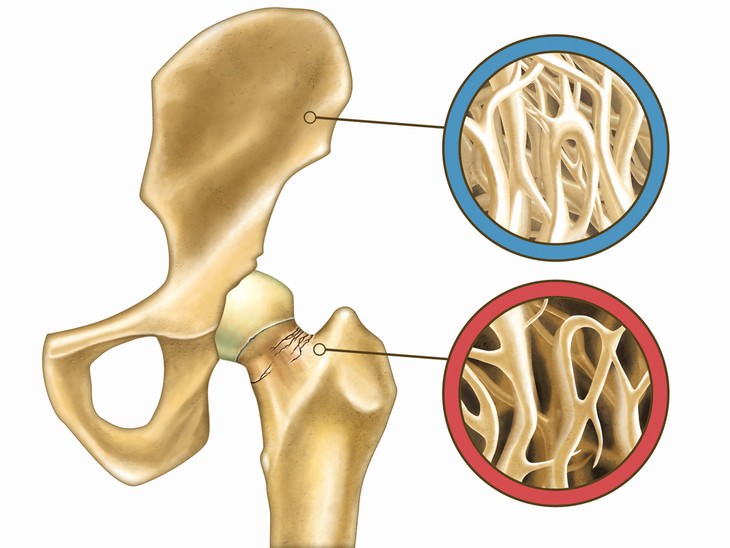
In specific cases, drinking a lot of milk may actually decrease bone density and cause osteoporosis.
Research has found that adult women who drank a lot of milk were more prone to bone fractures, maybe due to lactose and galactose contained in milk.
A different study concluded that osteoporosis anad a higher incidence of bone fractures in elderly adults may be because they consumed a lot of dairy, animal protein and calcium.
The picture below illustrates a healthy bone ( in the blue circle) and a porous one, affected by osteoporosis ( in the red circle)/
2. Teens and adults with acne
Milk may trigger or worsen acne symptoms.
A study found that teenagers with acne drank a lot of low-fat or skim milk. Dairy may cause adult acne as well. Although the reason is unknown, scientists believe it may be due to the carbohydrates and whey proteins contained in milk.
3. Kids and adults suffering from allergies.
Milk maybe the most common food allergen in the world. Over 5% of children are allergic to cow’s milk, though some children may grow out of the allergy.
Sadly, it is possible for adults to develop a milk allergy as well.
The symptoms of a milk allergy are the following
Skin reactions
Wheezing
Difficulty breathing
Constipation
Diarrhea
Blood in stool..
4. Eczema and Rosacea sufferers
Eczema can be worsened or triggered by milk and dairy.
Dairy products and milk, in particular, may also cause rosacea in adults. If you find that you experience a flare-up of your skin condition when you drink milk, better exclude it from your diet.
5. Lactose intolerance and sensitivity
It is estimated that about 75% of the world’s population is lactose intolerant to some degree, as estimated in a 2015 review article. Although most people with lactose intolerance can eat diary in small amounts with no ill effect, bigger amounts of milk and diary may cause digestive issues, such as-
Bloating
Vomiting
Diarrhea
Constipation
A sensitivity to casein, one of the proteins found in milk, is another story. It is different from an allergy or lactose intolerance. It triggers inflammation in any part of the body, which exhibits itself in the form of the following symptoms.
Migraines
Sinus congestion
Acne flares or any other rash on the skin.
6. People suffering from cold symptoms
Australian researchers suggested that consuming milk may worsen cold symptoms. In particular, it can make you phlegm thicker, which can cause further discomfort and irritation to an already0sensitive throat and nose.
It is a myth, however, that milk makes you produce more phlegm when you’re sick, it feels that way because it is thicker.
7. People at risk of specific cancers
Research suggests that milk consumption can be linked to prostate, breast and ovarian cancers.
The risk of prostate cancer ay increase with excess calcium consumption.
The sugars contained in milk may heighten the risk of ovarian cancer.
Cows given growth hormones that produced milk may increase the incidence of cancers of the reproductive organs and breast cancer among the consumers.

No comments:
Post a Comment